
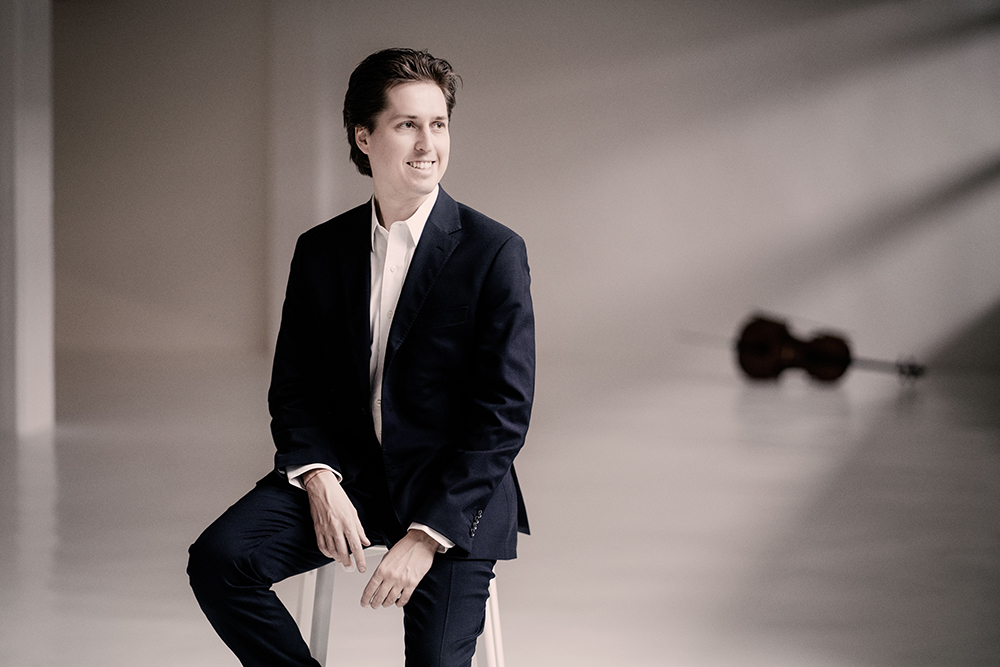
“Being an artist is not only a privilege and a pleasure, but also a great responsibility.“Being an artist is not only a privilege and a pleasure, but also a great responsibility.One can achieve and shape a lot – it’s a unique opportunity” Alexey Stadler
One musical highlight follows the next: as a soloist with orchestras such as the San FranciscoSymphony, the Deutsches Symphonie-Orchester Berlin, the Deutsche KammerphilharmonieBremen, the NDR Radiophilharmonie, the Liverpool Philharmonic Orchestra, the BBC NationalOrchestra of Wales and the Orchestra della Svizzera Italiana, Alexey Stadler has received greatacclaim.
“It‘s captivating the way he plays.” Tagesspiegel
Stadler has played under conductors such as Michael Sanderling, Vasily Petrenko, VladimirAshkenazy, Constantinos Carydis, Elim Chan, Robert Trevino, Valery Gergiev, Marek Janowski,Antony Hermus, Anu Tali, Stanislav Kochanovsky and Dan Ettinger. His chamber music partnersinclude notable artists such as Jörg Widmann, Igor Levit, Alice Sara Ott, Viviane Hagner, theSchumann Quartett and the Quatuor Ébène, as well as many other distinguished musicians andensembles. He has left a lasting impression at international festivals, such as the Schleswig-HolsteinMusic Festival, the Heidelberger Frühling, the International Chamber Music Festival Stavanger, theMenuhin Festival Gstaad and the Mecklenburg-Vorpommern Festival.
“Alexey Stadler is impressive and impeccable.” The Amati Magazine
The cellist, who combines musical depth and cultural vision, is now looking forward to animportant season 2025/2026: Performances with the Orchestra della Toscana, the RheinischePhilharmonie, at the Beethoven House Bonn, and at the NFM Wrocław are among his upcomingengagements.
Starting in October 2025, Alexey Stadler will be Artist in Residence with the ThüringerPhilharmonie Gotha-Eisenach. This first year-long collaboration with DIALOGI e.V. will open up awealth of exciting musical and cultural projects. The focus will be on symphonic and chamberconcerts, school performances, and appearances in unusual venues, complemented by workshops,masterclasses, conversation concerts, and formats dedicated to the culture of remembrance.
“Stadler’s performance gained an ever-increasing sense of inwardness that seemed to go to thevery heart of the piece.” The Guardian
Born in St. Petersburg, Stadler initially received intensive instrumental training and simultaneouslystudied music theory, harmony, and orchestration at the Rimsky-Korsakov Music College, where hegained an understanding of the fundamentals of musical language and its essential foundations, ashe emphasizes himself. His journey soon took him to international stages, where he received celloguidance from prominent figures like Frans Helmerson and David Geringas, who paved the way forhis further development.
Following their recommendation, Alexey Stadler met Prof. Wolfgang E. Schmidt who accompaniedhim throughout his artistic studies, from his bachelor‘s degree to his Konzertexamen. TheUniversity of Music FRANZ LISZT and the cultural city of Weimar became Stadler‘s new center oflife. A period of intensive musical work began that was soon rewarded with a jump into aninternational career. The kick-off was the first prize at the Hamburg TONALi competition in 2012 –the other events followed in quick succession.
Stadler achieved his international breakthrough and has since performed as a soloist with orchestrasworldwide. Under the influence of important mentors such as Steven Isserlis and Sir András Schiff,the soloist has shaped his musical profile. Since 2023, he has been passing on his knowledge to theyounger generation: as a professor of cello, Alexey Stadler teaches at the Hochschule für Musik undTheater Hamburg. He attaches particular importance not only to treating his students as equals, butalso to maintaining a strong connection with the audience.
“I admire artists who have a strong profile, always go into depth with their musical work, and careabout the world. Reproducing with playing without asking questions – that’s not enough for me.”
Whether with the first cello concerto by Dmitri Shostakovich or the cello sonata by AlfredSchnittke – providing context for both core and lesser-known repertoire is essential to AlexeyStadler. He is beginning to look for a way to give his own concerts such an additional value, toestablish a connection with the audience, to intensify it and, above all, to maintain it. At theinternational chamber music festival Krzyżowa-Music in Poland, where Alexey Stadler works asartistic advisor and curator of the symposia, one can see how closely global events are linked to theartistic work. The historically rich setting of Krzyżowa, known as a site of resistance and a symbolof German-Polish reconciliation, is central to every concert.
The cellist had a memorable experience at a young age: he heard Olivier Messiaen‘s Quatuor pourla fin du Temps in a concert without any background knowledge and therefore without any lastingimpression. The piece refused to open up to him. At a later date, Stadler learned the circumstancessurrounding the work: composed in 1941 “In honor of the angel of the apocalypse, who raises hishands to heaven and says ‘There will be no more time’” in the Görlitzprisoner-of-war camp and premiered in front of 400 prisoners in the freezing cold. Stadler heard thework again, was moved and touched. He realized how much a context can shape one’s own concertexperience. Moreover, what unexpected emotions can be awakened through this approach.
“It was the same piece. But it suddenly had an emotional context for me – I listened differently andcried afterwards.”